.png)
Knee Blocks and Rider Biomechanics
- Jan 31
- 6 min read
In last week’s blog post, I discussed why individual physical ability and rider biomechanics must be taken into account when we assess rider position. Riders do not all arrive in the saddle with the same joint range, strength, coordination, or capacity for movement – and equipment cannot override those differences.
One of the responses to that post was a familiar one: that the rider simply needed better knee blocks to hold her leg in the “correct” position, and that from there she would gradually become stronger and more stable.
This idea is widespread, well intentioned, and often presented as supportive. However, it fundamentally misunderstands what knee blocks can do – and what they cannot.
Knee and thigh blocks can influence where the leg rests and provide feedback to the rider.
What they cannot do is create hip movement, pelvic control, strength, or neuromuscular coordination that does not already exist. Expecting a rider to “strengthen into” a position simply by being held there by the saddle reverses how human movement actually develops.
Discussions around knee blocks often focus on equipment-based solutions. This blog instead examines the issue from a human movement perspective, where physical capacity and motor control are central to how position is achieved and maintained. It explores knee blocks through the lens of human movement science and physiotherapy, and explains why external support cannot create physical capacity – and why attempting to do so often leads to compensation rather than improvement.
What does the research say about rider biomechanics and thigh blocks?
There is currently very limited research specifically examining knee and thigh blocks in riding. However, one rider biomechanics study in elite riders compared a more vertical, restrictive thigh block with a design that conformed more closely to the rider’s thigh. The less restrictive design allowed:
greater rider movement
improved rider–saddle interaction
more favourable changes in horse movement
This finding is particularly important because elite riders are the group most likely to cope with restrictive equipment. If even highly skilled riders demonstrate reduced movement with more vertical blocks, it raises important questions about how these designs affect more novice riders or those with physical limitations or pathology.
A clinical example

In this session, the rider brought her own saddle. In the left and middle images, you can see that her thigh is not parallel to the knee block, as it ideally should be – with or without stirrups. This reflected her current physical capacity. At that point, she did not have sufficient hip extension (active or passive) available to allow the thigh to relax and sit parallel to the block. Rather than the block placing her into a better position, her body adapted around it. Her knee moved slightly over the block because that was the position her hips and pelvis could tolerate at the time.
It was only through physiotherapy treatment and targeted exercises that she was able to access the hip extension required to allow the leg to settle into a more neutral position. Once that capacity improved, the relationship between her thigh and the block changed naturally – without altering the saddle or block.
This is an important distinction. The knee block did not improve her position – it highlighted the limit of her movement. Until that limit was addressed, the block could not create a better outcome and instead became something her body compensated around.
The fundamental principle
In human biomechanics, there is a clear and well-established principle:
A forced position does not create physical ability.
It is physical ability that determines which positions can be achieved and maintained dynamically.
Strength, mobility, coordination, and joint health are properties of the rider’s body. Equipment can influence posture and provide feedback – but it cannot replace these qualities.
Claim 1:
“A correctly placed knee block will push the leg back and allow it to drop into a neutral middle position”
This assumes that leg position is primarily a matter of the rider not being able to hold their leg in the correct place, and that once positioned there it will automatically relax.
In reality, a relaxed leg position depends on:
the ability to maintain a neutral pelvis
adequate hip extension (and strength in hip flexors to allow leg to 'drop' down)
appropriate activation of the posterior thigh muscles
trunk stability
A knee block can change where the leg rests, but it cannot change how the pelvis is oriented or how the hip joint functions.
If the rider does not have the required hip extension or pelvic control, the body will still seek the path of least resistance. Common compensations include:
anterior pelvic tilt
lumbar extension
bracing the thigh against the block
The leg may appear more vertical, but the underlying mechanics have not improved. From a clinical perspective, this is not the leg “dropping” into position – it is the spine and pelvis adapting to an external constraint.
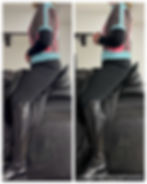
In this example, rather than the thigh resting over the block (like the other rider), they tipped their pelvis and trunk forward so that their thigh matched the block. Even though the block itself was relatively short and not excessively vertical, it encouraged a forward pelvic position that felt supportive and familiar to the rider, because it matched how she normally rode.
Returning to an upright, neutral pelvic position required body awareness and control of hip extension, both on and off the horse – not because of knee blocks.
Claim 2:
“If a rider cannot keep their leg back at the correct stirrup length, they need a block to stabilise it”
This assumes the primary limitation is leg instability.
In many riders, particularly those with pain, restriction, or pathology, the limiting factors are instead:
reduced hip extension or hip flexor weakness
limited pelvic control
joint stiffness or degeneration
protective motor patterns driven by pain
Human movement research consistently shows that external stabilisation leads to:
reduced muscle activation in stabilising muscles
altered motor control strategies
increased reliance on passive support
Stabilising a limb externally does not train the nervous system to control it. It removes demand rather than building capacity.
Claim 3:
“The hips are not a factor – block placement doesn’t change how wide the hips sit”
This reflects a misunderstanding of hip biomechanics.
The issue is often not hip width (abduction – although it can be), but other hip movements such as:
extension
rotation
the pelvis–hip relationship under load
A rider can have acceptable hip width and still be unable to extend or control the hip joint when sitting in the saddle, particularly in cases of osteoarthritis, previous injury, or long-standing restriction. Knee blocks do not increase joint range, joint health, or motor control. They only change where the thigh contacts the saddle.
Claim 4:
“Encouraging the leg into the correct position allows the body to catch up and re-strengthen over time”
This directly contradicts how strength and motor control develop.
Across rehabilitation science:
muscles strengthen in response to active demand
motor control improves through active movement and correction
passive support reduces, rather than increases, muscular engagement
If reduced demand created strength, we would rehabilitate injuries by holding people in ideal positions. We do not – because it does not work.
Claim 5:
“This works with many riders”
Visual improvement or short-term stability does not equate to improved biomechanics.
Clinically, many interventions may:
look better
feel more stable
reduce immediate symptoms
Yet result in:
long-term dependency
reduced movement variability
ongoing compensation patterns
Are knee blocks needed?
I do not believe knee blocks are necessary for a stable lower leg.
They can be helpful at times, especially in more advanced dressage riders, particularly as a reference point or for feedback – but they are not required for a rider to achieve or maintain a correct, functional position.
If a rider cannot maintain their position with longer stirrups without relying on a knee block, or if the knee consistently sits over the block when the rider is otherwise in the “correct” position, that is a signal to look more closely at the rider’s physical capacity rather than just the saddle.
Why the saddle is not the place to train physical limitations
If a rider does not have the strength, mobility, or joint capacity for a position, the saddle cannot provide it.
The saddle’s role is to:
allow movement
accommodate existing ability
avoid forcing compensation
Training physical capacity belongs off the horse, through targeted movement work and progressive loading within available range.
A clinical perspective and next steps
As a rider physiotherapist, my role is to assess:
what a rider can genuinely control
what movement is available
where compensation is occurring
From there, saddle fit should support that reality – not override it.
If you recognise yourself in this discussion, it may not be an equipment issue at all.
Through the Riding Ready subscription (coming soon), you’ll be able to assess and work through the physical limitations that affect your position and movement with rider-specific exercises.
For riders wanting a more hands-on approach, rider physiotherapy sessions allow you to bring your own saddle so we can assess how your body interacts with it, identify compensation patterns, and determine what needs to change in the rider – and what simply needs to be accommodated by the saddle.


