.png)
Have We Taken Rider Saddle Fitting Too Far? It All Starts With the Seat Bones For Me.
- May 31
- 10 min read
This is one of those blogs that I suspect won't be universally popular, but it's something I've found myself thinking about more and more over the last few years.
The comments I get from saddle fitters on my social media posts about rider position can be quite interesting. Many seem completely focused on the saddle and surprisingly reluctant to look too closely at the rider's position, anatomy, movement options or physical ability. Instead, there is often a very generalised statement that the rider's position is being caused by the saddle.
Now, if I was being cynical, I could argue that this is because selling a new saddle is their business. Equally, I need to acknowledge that I have my own bias too. I'm a rider physio. I make my living helping riders understand their biomechanics, improve their movement and develop the physical abilities needed for riding. None of us are completely neutral. The difference, I think, is that I'm quite happy to change my opinion if good evidence comes along, and I base what I say on medical and sports science knowledge and evidence, not just riding knowledge.
Before anyone gets too upset, I'm not saying saddle fit doesn't matter. Of course it does. In my opinion, especially as an equine physio, the horse comes first, and if the saddle doesn't fit the horse properly then nothing else really matters. A saddle that creates pressure points, restricts movement or causes discomfort to the horse isn't the right saddle, regardless of how comfortable it feels for the rider.
Once we have a saddle that fits the horse, however, I think the conversation around rider fit sometimes becomes more complicated than it needs to be, and I'm not always convinced that the confidence with which some claims are made is matched by the quality of the evidence behind them. To me rider saddle fit starts with a saddle which fits their seat (bottom and thighs) and leg length and then needs to look to balance and function.
As a rider physio, I spend most of my time looking at riders rather than saddles. I'm interested in how riders move, whether they can maintain balance, how stable they are, whether they can control their pelvis, and whether they can access the movement options needed for riding. Because of that, I tend to approach the whole topic from a slightly different perspective.

This illustration is where I start with every rider - looking at what their seat bones are doing, where their weight is going and what that is doing to their pelvic position.
When I talk about a neutral pelvis, I'm not talking about everyone looking the same. Riders come in different shapes and sizes, with different proportions, different levels of mobility and different pelvic anatomy. A neutral pelvis for one rider may not look identical to a neutral pelvis for another.
What I'm interested in is whether the rider can comfortably weight bear through their seat bones in a way that allows force to travel down through the structures that evolved to accept load. The seat bones act a little bit like a rocker. If you move too far forwards, you tend to roll off them in one direction. If you move too far backwards, you tend to roll off them in the other. Somewhere in the middle is a position where the rider feels balanced and, more importantly, where they can move from.
For me, that position is the foundation of rider position. Before we start discussing pelvic classifications, twist widths, seat impressions or any of the other things that often dominate saddle fitting discussions, I want to know whether the rider can find that balanced position on their seat bones and whether they can access the movements needed for riding from there.
The reason I start here is because riding isn't a static activity. The pelvis needs to be able to move forwards and backwards, side to side and rotate depending on what the horse is doing underneath us. The movements required in walk are different to those required in trot, canter or on a circle. If a rider cannot access those movements, then I would argue we have a rider problem long before we have a saddle problem. But it starts with a "ready position" like most sports have.
And this is where some of the more specific rider saddle fitting claims start to make me uncomfortable. One of the most common claims I hear is that certain riders need certain saddles because of their pelvic shape. The theory usually goes that men have one type of pelvis, women have another, and then various pelvic shapes require different saddle designs. The problem is that modern anatomy isn't nearly that tidy- we know now there is considerable variation within both sexes. The classic pelvic types - gynecoid, android, anthropoid and platypelloid - are not exclusive to one sex or the other. Human anatomy exists on a spectrum and there is often more variation within groups than people realise.
Yet many saddle fitting discussions still sound as though every woman has one pelvic shape and every man has another. Or worse, that every pelvic type requires a specific saddle design which, conveniently, happens to be available through the person making the recommendation and promoting their subscription or saddle.
That doesn't automatically make the recommendation wrong. Plenty of excellent professionals sell products they genuinely believe in. However, when highly specific claims are being made about matching pelvic shape to saddle shape, I think it's fair to ask what evidence exists to support those claims beyond theory, anecdote and experience. Ancedotal evidence which supports the products they sell, no matter how much data collected, is not useful unless it is allowed to be critically analysed after being published. Without knowing what they are measuring (and how and why) and their findings (what were they testing- pressure,range of movement etc) then it's all just numbers and ideas.
This becomes even more interesting when you look outside the equestrian world. Cycling has spent decades researching saddle pressure, saddle width and rider comfort. It's something I often reference in practice. One of the things that repeatedly appears in the research is that saddle interaction changes depending on posture. A cyclist sitting upright often loads the saddle differently from the same cyclist riding in an aggressive racing position. The pelvis rotates, the contact points change and the pressure distribution changes. Importantly, the cyclist's pelvis structure and shape hasn't changed. Their posture has. That raises an interesting question. If cycling, which has significantly more saddle pressure research than equestrian sport, recognises that saddle interaction changes with posture, how confident should we be that a single static impression of a rider's pelvis can determine the ideal saddle for an activity where the pelvis is constantly moving (or even not starting in the most functional and balanced position)?
I find myself asking similar questions when I hear some of the claims made about rider saddle fit because we've actually been here before in other industries. Years ago runners were routinely assessed based on whether they pronated or supinated. Depending on how your foot looked or moved, you were prescribed a particular type of running shoe. The theory sounded logical and was widely accepted.
The problem was that the research didn't really support it.
Over time, the focus shifted away from trying to categorise every runner and towards something much simpler.
Does the shoe fit?
Is it the correct width? (to allow toes to spread)
Is it the correct length? (to allow for toe and foot movement)
Is it comfortable?
Does it allow the movement required for the activity?
Has the runner got the mobility, strength, balance, body control and awareness for the task at hand?
I sometimes wonder whether rider saddle fitting is at risk of making the same mistake - creating increasingly complicated classification systems that sound scientific but aren't necessarily supported by strong evidence, just based on what the rider looks like.
My own experience certainly pushes me in that direction. At Pegasus Physio I have two main saddles available for riders - a jump saddle and a dressage saddle from Frank Baines. After trying a lot of different brands over the years, I found these offered a relatively neutral seat with enough room for different leg lengths and removable blocks when needed. Both are 18-inch seats. I also have a flatter Cavaletti Very Slightly Dressage saddle for riders who struggle with a higher cantle but still need a little more support than the jump saddle offers.

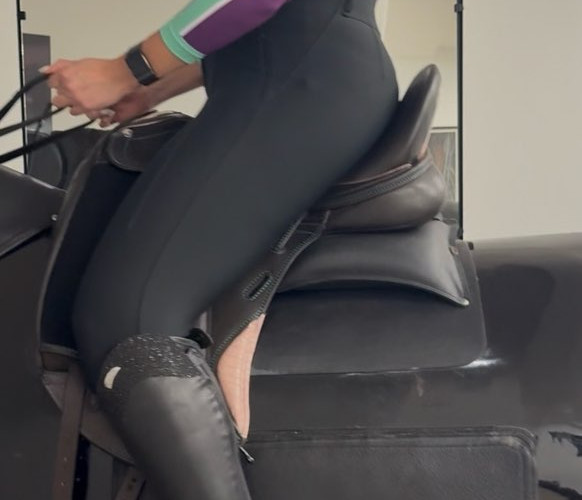





In these photos the rider goes from tilting and tipping forward with reins, to a more obvious arched lower back when not holding reins. Asking rider to lift legs over front of saddle shows where her seat was in the saddle (right against cantle) so getting her to shuffle forward and under slightly so weight going vertically down into seat bones and rider naturally brought rib cage over pelvis and shoulder over hip as balanced. The challenge then came when trying to maintain this position and lowering leg down into hip flexion. The rider couldn't open her hip angle more than here without losing that pelvic position. So we worked off horse on controlling hip extension through range with a neutral spine and pelvis and was able for leg to sit in a better place in the saddle afterwards.
So in reality, I have three saddles to work with riders of hugely different heights, weights, proportions, muscle mass, leg lengths and ability levels. If some of the more common rider saddle fitting theories were correct, that should probably be a disaster. Yet what I find in practice is that most riders do remarkably well. Not because the saddles fit everybody perfectly. They don't.But they don't seem to prevent riders finding a balanced position either.
I suspect that's because we're not spending the session trying to fit the rider to the saddle. We're teaching the rider how to find their balance point within the saddle.
Most saddles have a relatively flatter section in the seat and that's generally where I want the rider's seat bones to be. If they sit too far forwards, they often end up loading the pubic arch or soft tissues at the front of the pelvis, which quickly becomes uncomfortable. If they sit too far back, the cantle starts wrapping around the buttocks and often encourages them forwards. Somewhere between those two extremes is a position where the seat bones can accept load vertically and the rider feels balanced over the horse's centre of gravity. From that position they can then access the forward and backward, side-to-side and rotational pelvic movements needed for riding. That's what I'm interested in.
Once we have that balanced starting position we work on anterior and posterior pelvic tilt, lateral pelvic movement, rotation, trunk control and all the movement options required for riding. Yes, it's on a simulator rather than a real horse, but one of the things that makes the simulator useful is that it doesn't adapt to the rider. A horse will often compensate for us. The simulator simply keeps producing the same movement regardless of what the rider does, which makes stability problems very obvious.
Interestingly, many riders comment that the saddles feel comfortable despite being very different from what they ride in at home and technically "not fitting" them. That's not evidence and I'm not claiming it is. It's simply an observation from working with hundreds of riders.
What I find interesting is that this observation seems more consistent with what we see in other sports. Whether we're talking about cycling saddles, running shoes or sports
equipment in general, the trend has often been away from increasingly complex classification systems and towards equipment that fits, is comfortable and allows the athlete to move effectively.
The running shoe evidence is particularly interesting because for years the advice seemed incredibly logical. If somebody overpronated, they were prescribed a stability shoe. If somebody supinated, they were given a more cushioned shoe. If they had a neutral foot posture, they were given a neutral shoe. The assumption was that matching the shoe to the person's foot mechanics would reduce injury risk.
The problem was that when researchers started testing these ideas properly, the results weren't nearly as clear as people expected. Large studies repeatedly failed to show meaningful reductions in injury rates when runners were matched to shoes based on foot posture alone. In fact, many runners with "poor" foot mechanics remained injury-free, while plenty with supposedly ideal mechanics still developed injuries.
Over time, researchers began to question whether they were focusing on the wrong thing. Rather than trying to categorise every runner into increasingly specific groups, attention shifted towards factors such as comfort, fit, allowing natural movement and ensuring the shoe was appropriate for the task being performed. That doesn't mean foot mechanics don't matter. They clearly do. It simply means that the relationship between anatomy, movement and equipment turned out to be far more complicated than the original theories suggested.
I sometimes wonder whether rider saddle fitting is facing a similar challenge. The theory that a particular pelvic shape requires a particular saddle shape sounds logical. The question is whether we actually have the evidence to show that those classifications consistently improve rider comfort, movement or performance, or whether we are still at the stage where the theory sounds more convincing than the data supporting it.
Ultimately, I think comfort matters, but comfort alone isn't enough. Plenty of riders are comfortable in positions that don't allow them to move effectively. What I'm interested in is whether the rider can comfortably weight bear through their seat bones, maintain a neutral position and access the movements needed for riding.
The more riders I work with and the more posts and comments I see online, the more I think some people are looking for a saddle solution to what is actually a rider problem. Or they are being a saddle to 'fix' their problem. Sometimes the saddle genuinely is the problem. But sometimes the rider lacks trunk stability. Sometimes they lack pelvic or lower back mobility. Sometimes they lack body awareness. Sometimes they simply haven't developed the movement skills needed for that level of riding yet.
No saddle can fix those things.
And that's why my focus will always be on helping the rider develop the understanding and physical capability needed to ride effectively rather than relying on equipment to compensate for them. Perhaps future research will prove that highly individualised saddle designs based on detailed pelvic measurements dramatically improve rider performance. If that evidence appears, I'll happily change my opinion. Until then, I'll continue focusing on what I know matters most - a saddle that fits the horse, a rider who can comfortably weight bear through their seat bones, and a rider who can move.
Want help with your position in the saddle? Book in for a Rider Physio session with the simulator in Cheshire or look at the new online Riding Ready Program (June 2026).


