%20(6).jpg)
Stirrup Length Isn’t About Discipline or Looking Right – It’s About Individual Rider Biomechanics
Updated: Jan 25
How Stirrup Length Can Hinder – or Help – Your Riding
Rider biomechanics from a rider physio perspective
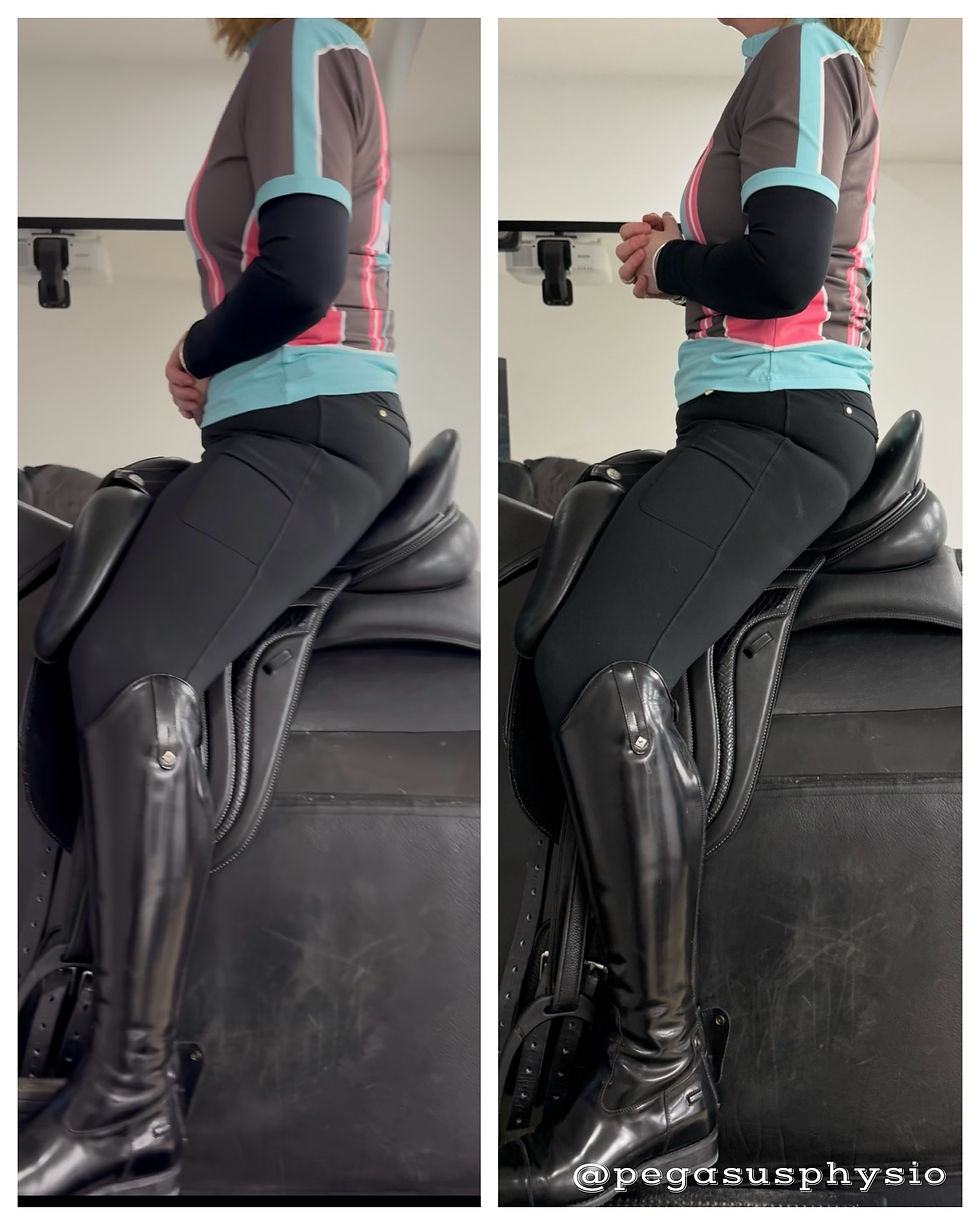
This week’s social media post about a rider with severely arthritic hips and restricted movement sparked far more debate than I expected. During that rider physio session, we shortened her stirrups to support her biomechanics in the saddle. Not to make her “ride short”, not because of discipline rules, and not for the sake of appearance – but to support her body in the saddle, reduce pain, and improve her balance and stability so her leg could actually relax and function.
The change was immediate. She was more balanced, more stable, and in significantly less discomfort.

What surprised me wasn’t that it worked – that part made complete sense from a physical point of view – but the reaction in the comments. Many people insisted the longer stirrups were “correct”.
Not by looking at the rider.
Not by looking at the change in her movement or comfort.
But simply because it was a dressage saddle, therefore the stirrups should be long.
Others argued that stirrup length depends purely on discipline – shorter for jumping, longer for dressage.
Some said a longer leg gives a deeper seat.
Some suggested a longer leg would score better in the show ring.
Others blamed the saddle, which misses the point altogether. A saddle does not suddenly give a rider more hip movement, more strength, or better control. It might improve the picture – knees less over the saddle flap, a longer outline – but the rider’s physical ability does not change just because the tack does. Saddles don’t magically put a rider into a good position, the rider has to have the physical ability to use that saddle and ride that horse.

All of this highlighted how little riders are taught about why stirrup length matters, and how powerful it can be when used as a tool rather than a rule.
So let’s break it down.
In a previous blog, I looked in more detail at stirrup length and why riding with no stirrups doesn’t automatically improve position, why the length that feels most comfortable isn’t always the most functional when we don’t look at what the body is actually doing, and why you don’t need to press into the stirrups in the same way you don’t press into the floor when walking or stepping up stairs.
Stirrup length and rider biomechanics
When a rider sits with no stirrups, essentially all of their body weight is transferred through the seat into the saddle. When riding in half seat – and even at the height of a rise in rising trot – the majority of weight is transferred through the feet. This has been shown repeatedly in studies measuring seat and stirrup forces, where load shifts dramatically as the rider comes out of the saddle.
Once a rider has their feet in the stirrups, weight is always shared between seat and feet.
Stirrup length changes how that sharing happens.
With longer stirrups, the feet are further away from the seat and from the rider’s centre of mass. From a rider biomechanics point of view, this increases the lever arm. A longer lever increases the rotational forces acting on the pelvis and trunk. In simple terms, it becomes harder for the body to stay upright and stable without greater muscular effort. The leg can also behave more like a pendulum, meaning small losses of control result in larger, more noticeable movements.
When stirrups are shorter, the feet are closer to the seat and closer to the rider’s base of support. The lever is shorter, so less torque acts on the pelvis, so maintaining an upright position with a neutral pelvis often feels easier. This is why many riders report feeling more stable and balanced with slightly shorter stirrups. because it takes less muscular effort for the same outcome in the seat.
When the feet are closer to the seat, there is less distance over which the rider’s body weight has to be distributed. This allows a greater proportion of weight to pass through the feet simply because they are better positioned to support load. When the feet are further away, less weight is transmitted through them and more is carried by the seat, regardless of muscular effort. So more weight in feet and less in seat with shorter stirrups with more weight in seat and less in stirrups with longer stirrups.
I think this is also where the belief that longer stirrups create a deeper, more connected seat comes from. As with longer stirrups, more of the rider’s weight is directed into the seat simply because less can be supported through the feet. When a rider has the physical ability to manage this, small changes in pelvic position and weight distribution can be transmitted clearly to the horse, reinforcing the idea of improved connection.
However, this connection does not come from leg length itself. It comes from the rider’s physical ability and skill level. Elite riders often ride with long stirrups because they have the pelvic stability, hip mobility, and postural control required to manage the increased demands of that position – not because the long leg automatically creates a better seat.
Without sufficient pelvic stability, hip mobility, and postural control, the additional weight in the seat associated with longer stirrups does not improve communication. Instead, the rider may struggle to remain stable and begin compensating with other muscle groups in an attempt to stay upright under the increased physical demands that longer stirrups create.
What stirrup length does to the hips
Stirrup length doesn’t just change weight distribution – it changes joint angles, and joint angles change how the leg muscles work.
With longer stirrups, the hip and knee joints are held in more extension (straighter) compared to shorter stirrups, where both joints are more flexed. This change in hip and knee angle alters how different muscles contribute to pelvic stability and leg control. Muscles generally work best in mid-range, where they have the most effective length–tension relationship and can respond efficiently rather than simply hold position.
Joint position also affects proprioception. When joints are working closer to mid-range, the nervous system receives more continuous and higher-quality proprioceptive feedback about joint position and movement. This allows the brain to make quicker, more subtle balance corrections. When joints are closer to end range, proprioceptive input becomes more protective than regulatory, which can increase stiffness and reduce fine control. This is another reason why shorter stirrups often feel more stable and more effective, even without the rider consciously trying to do anything differently.
Shortening the stirrups brings the hip back into a more functional mid-range. The rider doesn’t suddenly become stronger – the muscles are simply placed in a position where they can work as intended.
It’s also important to recognise when longer stirrups may not be appropriate for a particular rider. A common example is riders with restricted hip mobility or hip arthritis, lower back pain etc. Longer stirrups push the hip closer to end-range extension, where muscles lose mechanical advantage, torque demands increase, and the body begins to compensate. Riders may grip with the thighs (often through the adductor muscles), brace through the lower back, tip the pelvis, or feel generally unstable – not because they’re riding badly, but because the position is asking more than their body can comfortably provide.
The solution isn’t to keep repeating the same position and hope for a different result. It’s to assess the rider’s available hip movement off the horse in a neutral pelvis, understand how much hip extension they can realistically manage, and then observe on the horse which stirrup length allows them to achieve balance, stability, and control without compensation.

Lower leg stability and stirrup length
Lower leg stability is not created at the ankle – and it isn’t created by forcing the heel down. It is controlled largely by the muscles at the back of the leg, particularly those that act behind the knee joint, with the hamstrings (the muscles at the back of the thigh) playing a key role.
With longer stirrups, the knee sits closer to straight and the hamstrings are lengthened. As discussed earlier, muscles generally work more effectively and with better-quality proprioceptive feedback when they are operating in mid-range rather than near end range.
When the knee is closer to straight, the hamstrings are working at a mechanical disadvantage and have a harder job providing fine control in a long stirrup compared to a shorter one.
This is why riders with longer stirrups often struggle with a swinging or creeping lower leg, even when they are actively trying to keep it still. They are often also working harder to maintain a neutral pelvis and upright trunk. As the horse starts to move, small losses of balance in the upper body create tipping moments, and the legs then attempt to counterbalance or pivot from the hip in an effort to regain stability. The swinging leg is often a result of this process, not the original fault.
This becomes even more apparent when more weight is transferred into the stirrups, such as in rising trot. With longer stirrups, the foot is further away from the pelvis, creating a longer moment arm around the knee and hip – in simple terms, the weight is acting further away from the joints that have to control it. A longer moment arm increases the rotational force acting on the lower leg, meaning the muscles have to work harder to prevent it from swinging. With shorter stirrups, the foot is closer to the body’s centre of mass, the moment arm is shorter, and the same weight transfer creates less rotational demand. As a result, the lower leg is easier to stabilise without gripping or excessive muscular effort.
Jump seat, light seat, and why longer stirrups make it harder
These differences become particularly obvious in jump seat or light seat.
In an effective jump seat, the rider lifts out of the saddle by hinging forward at the hips. The pelvis moves slightly back, the trunk inclines forward in balance, and the rider can hover just off the saddle without losing stability. This movement relies on having sufficient hip and knee flexion to allow the hip joint to close.
When stirrups are shorter, the rider starts with the hips and knees already flexed. That makes hinging forward possible, allowing the rider to lift slightly out of the saddle while keeping the lower leg relatively stable underneath the body.
With longer stirrups, the knee is closer to straight and the hip more open, leaving far less room to hinge. To get out of the saddle, the rider often has little option but to stand by straightening the knees further. This shifts the rider’s centre of mass forward and upward, often ahead of the base of support. As the trunk tips forward, the lower leg is pushed back, and the rider loses the ability to stay folded through the hip. The leg then swings as the rider tries to regain balance – not because of poor technique, but because the joint angles force standing rather than hinging.
Discipline, saddles, and reality
Dressage and jumping place different demands on the rider, and saddle design reflects that. Dressage is predominantly ridden sitting, with more weight remaining in the seat and a need for subtle pelvic control. Jumping requires more time in half seat, with frequent weight transfer into the feet.
Dressage saddles encourage a longer leg and deeper seat, often supported by large thigh blocks and a stirrup bar closer to where the riders centre of gravity will be (around seat bones in a neutral pelvis) . But sitting deeply with a neutral pelvis and independently moving hips is physically demanding. Dressage saddles don’t create that ability – they assume it already exists.
Jump saddles, with stirrup bars set further forward, allow weight in the stirrups to shift the rider’s centre of mass forward, making hinging easier. Trying to force jump-style movement in a dressage saddle often highlights just how much joint angle matters.
So what stirrup length should we actually use?
The answer is simple, even if it challenges tradition: the stirrup length that best supports your body.
A functional stirrup length is one that supports the leg in a relaxed way, with the ball of the foot on the stirrup and the stirrup sitting roughly parallel to the floor. Without that, any weight that goes down into the foot is more likely to cause the leg to swing – or force the rider to grip to stop it swinging.
It should be a length that supports a neutral spine and an upright trunk, with the ribcage stacked over the pelvis and the shoulder over the hip, without excessive muscular effort. In other words, a position where balance feels natural rather than forced.
The most “correct” stirrup length is the one where the rider is most balanced and stable – because balance is what leads to security, not how long the leg looks.
Only after that do we consider discipline and saddle. Not as rules, but as context. Is the aim to lengthen stirrups for dressage because we think that’s what we should do? Or is the current length what actually allows the rider to sit, move, and transfer weight into half seat when needed while remaining balanced? And the goal is a longer leg?
It isn’t just about the saddle or the discipline. It’s about the individual rider – what they can do now, what they need to be able to do, and how we work towards that.
Riding Ready: Position before Movement
This is exactly why I’ve created Riding Ready subscription, launching at the end of February 2026. Riding Ready is built around rider biomechanics and rider physio principles, focusing on position first and then the movement required to support it. Riding is broken down into its components, ensuring riders have the physical ability to do what is needed – based on anatomy and physics, not generalised riding expressions or rigid “rules”.
In rider physio sessions, we often change stirrup length multiple times. Sometimes shorter, sometimes longer. As we work on pelvis and trunk position, we adjust stirrups to find that optimum Riding Ready Position – the position where the rider is most balanced, most stable, and most able to move with the horse rather than fight their own body.


Comments